Most men pick a shampoo the same way they pick a gas station — whatever is closest and cheapest. Then they spend years wondering why their scalp itches in the winter, why there's dust on their collar by lunchtime, or why their hair feels like straw two days after a cut.
Here's the thing I tell guys in my chair: the label on the back of the bottle is a spec sheet. You'd read the spec sheet before buying an engine or a watch movement. Your scalp deserves the same ten seconds.
First: Your Scalp Is Skin, Not Hair
This is the part almost nobody gets right. The hair you can see is dead keratin — it has no blood supply, no nerves, and no way to repair itself. Everything that actually determines whether your hair grows in thick, healthy, and shiny is happening underneath, in living skin.
That skin has oil glands, a resident population of microbes, and a turnover cycle of roughly a month. Treat it like an extension of your face and most "hair problems" start solving themselves. Treat it like an afterthought and no styling product on earth will cover for it.
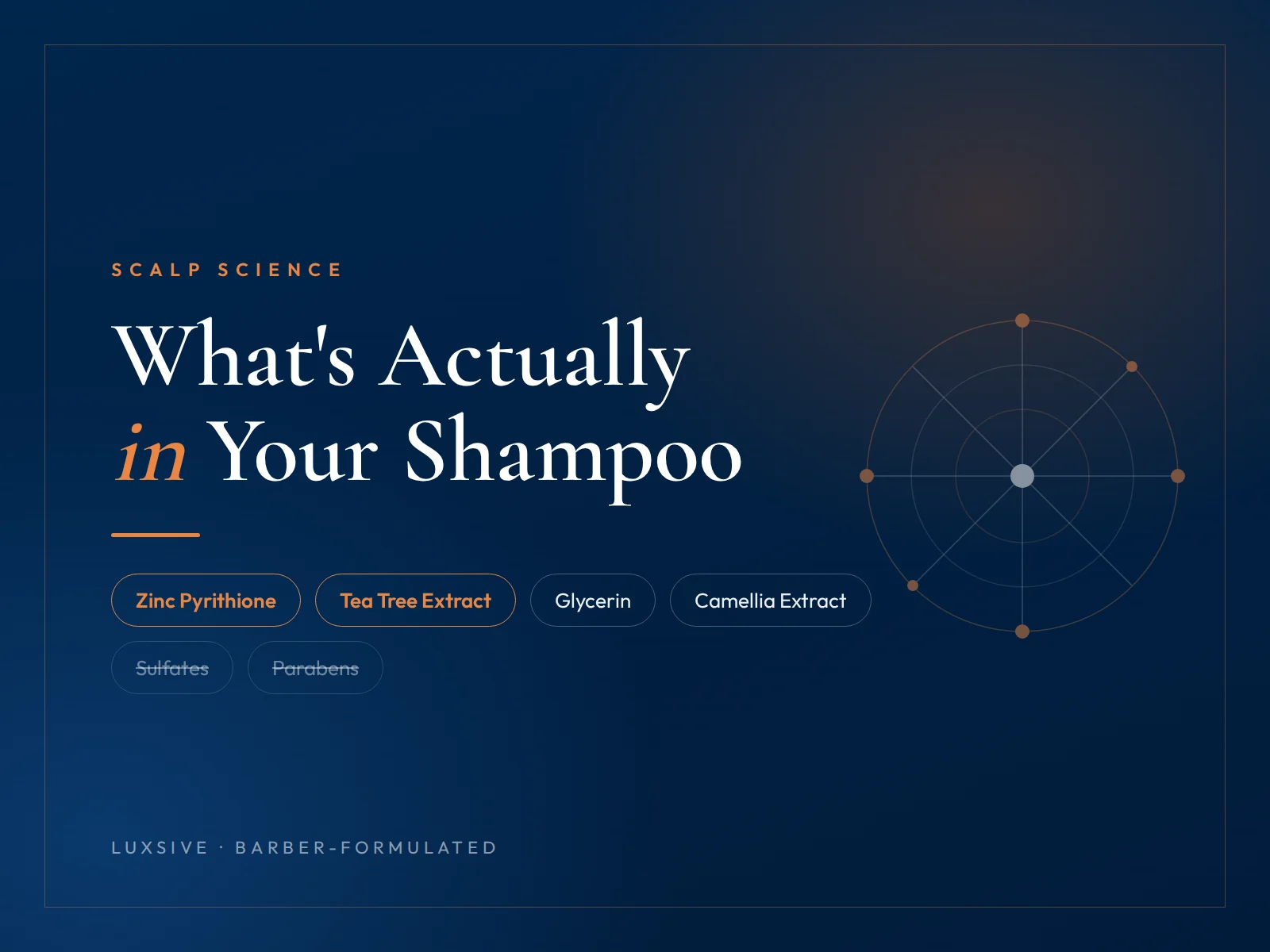
The Five Ingredients Worth Knowing
1. Zinc Pyrithione
The workhorse. Zinc pyrithione is an antifungal and antibacterial agent that targets Malassezia, a yeast that lives on nearly everyone's scalp and, in some men, feeds on scalp oil and triggers the irritation and flaking we call dandruff. It's one of the most studied anti-dandruff actives in the world, and it's why a proper shampoo can calm a flaky scalp when a "clarifying" body-wash-in-disguise can't.
What it means for you: if you flake, this is the word you're looking for on the label.
2. Tea Tree Extract
Tea tree has natural antimicrobial properties and a cooling, soothing effect on an irritated scalp. It also handles something men care about more than they admit — the smell that builds up in a beard by day three. It pairs well with zinc pyrithione: one goes after the cause, the other calms the symptoms.
3. Glycerin
A humectant, which is a fancy way of saying it pulls water in and holds it there. This is what keeps a cleanser from leaving your scalp tight and squeaky. Squeaky isn't clean — squeaky is stripped.
4. Camellia Extract
Lightweight conditioning from the camellia plant, rich in fatty acids and antioxidants. It softens hair and beard without the heavy, greasy film that heavier oils leave on fine hair. If your hair goes limp the second you put anything on it, this is the category of ingredient you want.
5. Cocamidopropyl Betaine
The surfactant — the ingredient that actually cleans. It's a mild, coconut-derived cleanser that lifts oil and dirt without the aggressive stripping of harsher alternatives. Every shampoo needs a surfactant. The question is only which one.
What to Watch Out For
- Sulfates (SLS / SLES): cheap, extremely effective foaming agents. They clean, but on a dry or sensitive scalp they strip the natural oil barrier and leave you itchier — and oilier — a day later. Big lather feels satisfying; it isn't a quality signal.
- Parabens: preservatives that keep products shelf-stable. Plenty of men would simply rather not, and formulating without them is entirely doable — which is why Luxsive does.
- Heavy silicones: they give you instant slip and shine, but the heavier ones build up over time and leave hair coated and dull until you strip it all off and start again.
- Denatured alcohol high on the list: fine in tiny amounts, drying when it's one of the first few ingredients.
One rule that costs you nothing: ingredients are listed in descending order by concentration. What sits in the first five lines is what the bottle actually is. Everything after that is mostly marketing.
Barber-Formulated
Sulfate- and paraben-free, with zinc pyrithione and tea tree extract — built for the scalp, not just the hair.
Shop LuxsiveFlaking Isn't Always Dandruff
Two different things get called dandruff in the barbershop, and they need opposite fixes:
- Dry scalp: small, fine, white flakes. Skin is tight, often worse in winter or after a lot of sun and salt water. It's a moisture problem — wash less aggressively and condition more.
- Seborrheic dermatitis (true dandruff): larger, oilier, yellowish flakes with redness and itching. It's driven by yeast and oil, not dryness — and it's the one zinc pyrithione is built for.
If your scalp is persistently red, painful, weeping, or losing hair in patches, that's past what a shampoo fixes. See a dermatologist — I say the same thing in my chair, and no good barber will tell you otherwise.
How to Actually Wash (The Barbershop Method)
- Lukewarm water, not hot. Hot water strips oil and inflames an already irritated scalp.
- Fingertips, not nails. You're massaging skin, not scrubbing a pan. Nails cause micro-scratches that make itching worse.
- Give it 60 seconds. This is the step everyone skips. Actives like zinc pyrithione need contact time to do anything at all. Lather, then work the scalp for a full minute before rinsing.
- Rinse longer than you think. Residue left behind is a common cause of dullness and itch.
- Condition the lengths and the beard — not the scalp. Shampoo is for skin; conditioner is for the hair shaft and facial hair.
How often? For most men, two to four times a week, adjusted for how oily you run, how much you sweat, and the Miami humidity. Daily washing with a harsh formula is the most common self-inflicted scalp problem I see.
The Short Version
Look for zinc pyrithione and tea tree if you flake. Look for glycerin and a mild surfactant if you run dry. Skip the sulfates. Read the first five ingredients and ignore the front of the bottle entirely. And give whatever you buy a full minute on your scalp before you rinse it off — the best formula in the world does nothing in four seconds.